The Ben Johnson Effect & More Fantasy-Friendly Team Styles From The Utilization Report
Adam Pfeifer breaks down how to use the Team Styles page of the Utilization Report to identify fantasy-friendly environments to target in your 2026 drafts.
Did I mention how incredible the Utilization Report is?
Last week, we kicked off a series highlighting some of the best aspects of the best tool in the game. It continues this week with a look at the team styles page, which shows schemes, pace, scoring, etc. It helps paint a picture of exactly how teams operate, helping us fully break down why fantasy players perform.
Here are three teams that stood out from this past season.

Join Our Newsletter
Trusted by 400,000+ fantasy football players. Get access to Fantasy Life's free award winning newsletter and tools, all in one step.
By registering or logging in, you agree to our Terms of Use and Privacy Policy.
 The Arizona Cardinals Just Kept Throwing
Volume is always a key to fantasy football success.
But for the 2025 Arizona Cardinals, it was THE key.
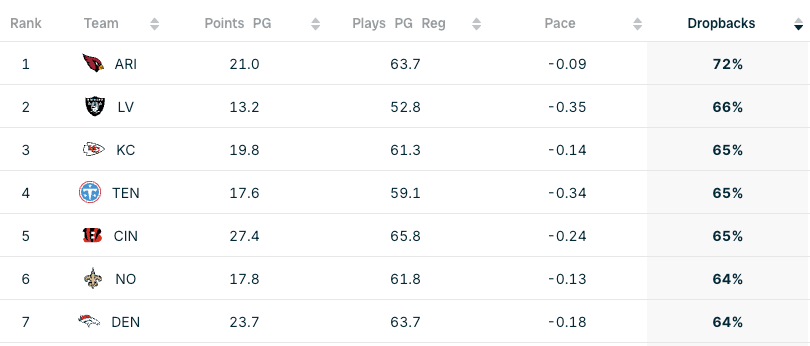
With zero run game to speak of and a plethora of trailing game scripts, the Cardinals aired the ball out more than any other team in football last season, but especially starting in Week 6. That’s when Jacoby Brissett took over at quarterback, and from that point on, Arizona led the NFL in dropback rate (72%) and dropback rate over expected (6%). I mean, just look at the immense passing volume out of Arizona once Brissett was under center:
- 40.6 pass attempts per game (1st)
- 309.2 air yards per game (2nd)
- 6% dropback rate over expected (1st)
- 65% pass rate when leading by 4-plus points (2nd)
- 55% inside 10-yard line dropback rate (10th)
That very volume helped Trey McBride lead all fantasy tight ends, while simultaneously propelling Michael Wilson into a must-start fantasy wide receiver. During that span, McBride and Wilson ranked first and second in routes run, averaging 42.5 and 39 per game, respectively. From Week 6 on, only the Jets trailed by at least eight points for more plays than the Cardinals, forcing Brissett to take to the air early and often, helping him average 18.9 fantasy points per game during that stretch (QB8).
Entering the 2026 campaign, Arizona has a new play caller in head coach Mike LaFleur, while the running back room got an overhaul, adding Jeremiyah Love and Tyler Allgeier. My guess? LaFleur and company try to get the run game going, but given their daunting schedule, Arizona will likely have to abandon the run in many point-chasing efforts over the course of the season. Perhaps this time Marvin Harrison Jr. will get to take advantage of Arizona’s high passing volume.
 The Ben Johnson Effect
We knew Ben Johnson was one of the most highly coveted head coaching candidates for years now. He’s innovative, fun and most importantly for our selfish purposes, schemes touches for the best players in his offense.
His impact on the 2025 Chicago Bears was very much appreciated.
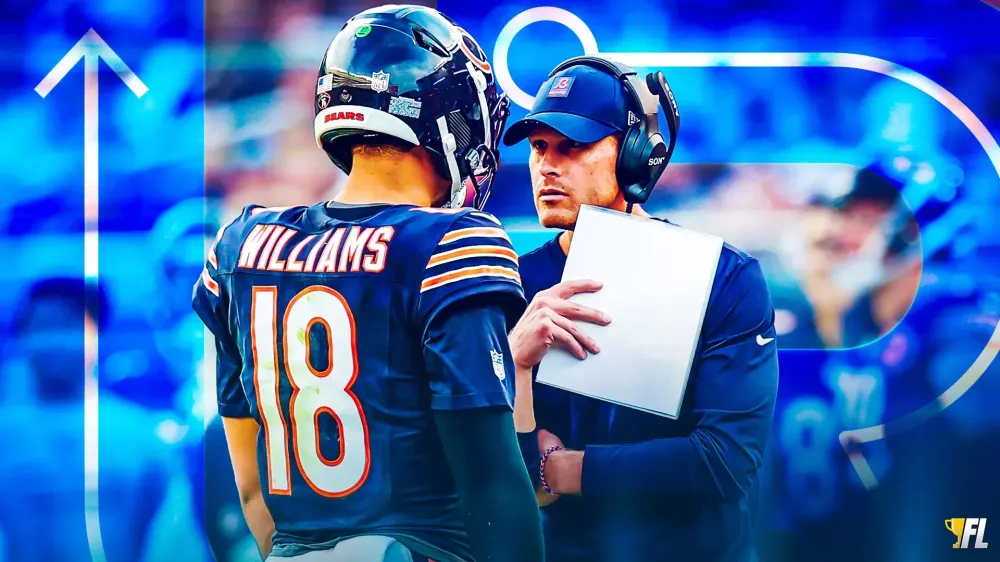
We saw a notable uptick in motion in Chicago with Johnson running the show. This past season, the Bears utilized shift-motion 60% of the time, the seventh-highest rate in the league. It was a massive improvement from 2024, when the Bears ranked just 20th in motion rate at 46%. Caleb Williams led the NFL in dropbacks (370) with motion on the play, while ranking second in pass attempts (337). His 19.8 pass attempts per game with motion were over four more per contest than his 2024 average. Motion is such a welcomed addition to any offense, not just because it helps put players in the best positions to win, but also serves as an answer to the test a quarterback has to take each time he steps to the line of scrimmage.
Of course, motion can also be beneficial to pass catchers. Whether it be free releases off the line of scrimmage or an easier path to designed touches, motion has led to a boost in fantasy production for wideouts. Once fully healthy and acclimated last year, rookie Luther Burden fit perfectly in Chicago’s scheme. From Week 11 on, 11 of Burden’s targets came from motion, with another 7 being wide receiver screens.
There was also a massive boost in another concept that is conducive to fantasy scoring: play-action. In 2024, Chicago utilized play-action just 18% of the time, the second-lowest rate in all of football. But Johnson came in and changed everything, boosting the play-action rate in Chicago to 33% this past season, the second-highest rate. Williams averaged 11.1 play-action pass attempts per game (2nd), while his 11 touchdowns were good for fourth-most. He was also a more productive fantasy quarterback when using play-action, averaging 0.57 fantasy points per dropback, compared to 0.47 without play-action. And it shouldn’t come as much of a surprise.
Dwain McFarland recently published an in-depth breakdown of what truly matters for fantasy quarterbacks and play-action (as well as motion), which made the list. His research illustrates that quarterbacks see a 28% boost in fantasy points per dropback when utilizing play-action over the last three seasons. So with Johnson implementing much more motion and play-action during his first season in Chicago, it’s no wonder Williams averaged over three more fantasy points per game this season.
Pace of Play
It’s no secret. More plays equal more opportunity for fantasy points.
Yeah, I passed math. So what?
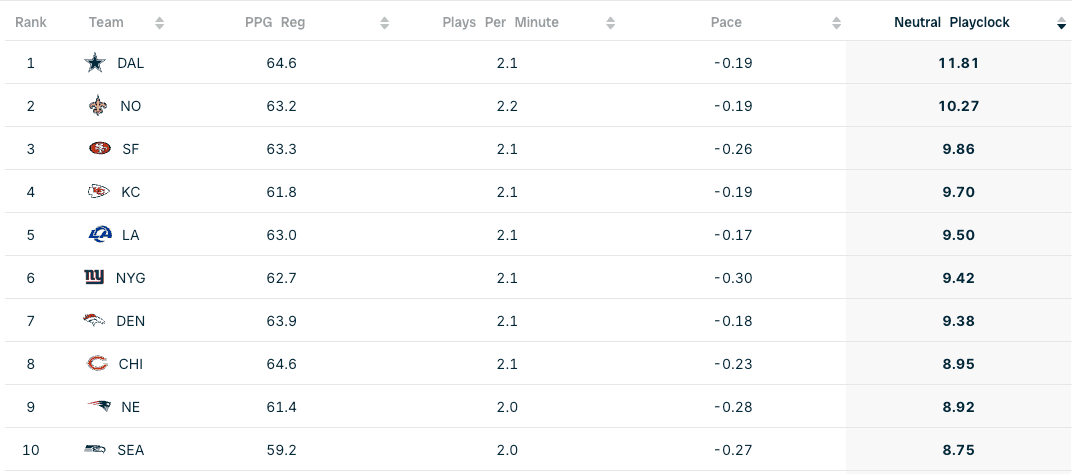
Targeting players on teams that play at the fastest pace can be advantageous for fantasy purposes, but also targeting players against those same teams. This past season, the New Orleans Saints were the breakout fantasy-friendly offense of the NFL. Led by new head coach Kellen Moore, the Saints led the NFL in plays per minute (2.2), while their 22.7% no-huddle rate trailed only the Washington Commanders. And in neutral game scripts, their average time left on the play clock was 10.27 seconds, the second-highest mark in football. Meanwhile, the Saints deployed shift-motion at the snap 64% of the time, the third-highest rate in football and an 11% increase from 2024 (pre-Moore). Everything about Moore’s offense was beneficial for fantasy purposes, helping Chris Olave and Juwan Johnson enjoy career years.
Olave and Johnson both ranked one and two in targets with 20-30 seconds left on the play clock (25 and 24, respectively), showcasing the blistering pace New Orleans played at. It propelled Olave to a WR7 PPG finish (16.8), while Johnson set career-highs in receptions (77), yards (889), targets (102) and PPG (10.6).
The Saints were clearly moving in their first year under Moore, but they weren’t the only ones pushing the pace.
One of Moore’s former teams, the Dallas Cowboys, also blessed fantasy players with the gift of tempo. Brian Schottenheimer and company ranked second in plays per minute (2.1), while their neutral play clock of 11.81 seconds actually led the league. Only the Chicago Bears ran more plays per game during the regular season than the Cowboys (64.6), boosting their already strong fantasy options. Quarterback Dak Prescott led the NFL in pass attempts with 20-30 seconds left on the play clock (78), while George Pickens was top-five in such targets. Schottenheimer was the team’s offensive coordinator from 2023-2024, operating fast offenses both seasons. But in his first season as head coach, he took it up a level.
Join Our Newsletter
Trusted by 400,000+ fantasy football players. Get access to Fantasy Life's free award winning newsletter and tools, all in one step.
By registering or logging in, you agree to our Terms of Use and Privacy Policy.
Players Mentioned in this Article

Published Updated